How Accurate Is AI Calorie Counting by Photo? What the Research Says (2026)
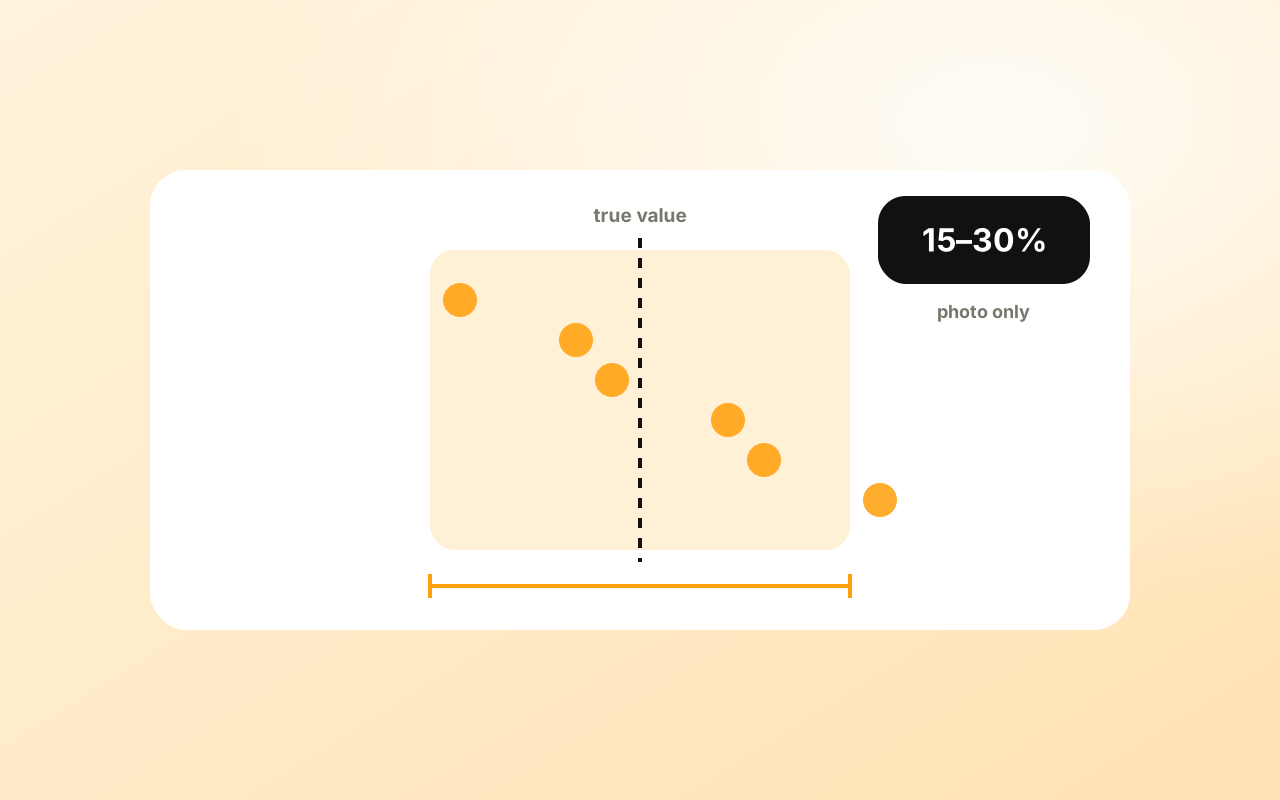
Quick answer: Photo-only AI estimates land within roughly 15–30% of the true calorie count on average — closer on a single simple food, further off on mixed dishes, sauces and anything hidden under something else. Adding a short text or voice description ("chicken breast, about 150 g, with rice") roughly halves that error. That is comparable to or better than how people estimate by eye, and far better than not logging at all. But it is an estimate, and any app claiming 95%+ accuracy on real-world meals is quoting a lab.
Why this question matters
Every AI tracker's marketing shows a plate, a camera and a confident number. Skeptics — dietitians, Reddit, people who tried one app and saw 380 kcal for a burrito — ask the obvious question: how does it know?
It does not "know." It estimates, in four steps, and each step can be wrong. Understanding those steps is the difference between using the tool well and being misled by it.
How photo calorie estimation actually works
Almost every photo-based app in 2026, including CalMePlease, runs a pipeline like this:
- Segmentation. The image is split into regions: plate, background, and each distinct food item.
- Classification. Each region is identified — grilled chicken, white rice, broccoli, sauce. This is where visually similar foods get confused: chicken thigh vs breast, white rice vs risotto, butter vs margarine.
- Portion estimation. The model guesses volume or weight from the image. Depth is inferred from a single 2D picture, which is the hardest part. Occlusion (rice under the chicken) and camera angle both hurt.
- Nutrient lookup. The identified food and estimated portion are matched to a nutrition database and multiplied out into calories and macros.
Errors compound. A 10% miss on portion plus a wrong database entry for the sauce can produce a 30% miss on the final number. This is why two apps can look at the same plate and differ by a third.
What the studies say
**Systematic review, 2023 (Shonkoff et al., Annals of Medicine).** Reviewed AI image-based dietary assessment against ground truth. Relative errors for calories ranged from under 1% to 38% across studies, with lower errors when images contained single or simple foods. Conclusion: AI methods match and can exceed human estimation accuracy, but performance varies enormously with the dataset.
Nutrients, 2025. Tested a current general-purpose AI model on food images. Image-only estimation: about 30.5% mean absolute percentage error. Image plus a short description of ingredients: about 13.9%. Context more than halved the error.
Fridolfsson et al., 2025. Tested ChatGPT, Claude and Gemini directly on 52 food images. Weight and energy error was just under 40% for the best two models and 65–70% for the third, with macronutrient errors of 42–110% — protein being the worst. General-purpose LLMs without a food-specific pipeline are notably worse than purpose-built apps.
Independent app benchmarks, 2026. Two separate six-app benchmarks (a clinical nutrition report and a May 2026 validation) found photo-only apps as a class had higher error than manual-plus-barcode workflows, with mixed dishes producing errors 50–70% larger than single-item plates. They also found that error direction matters: some apps chronically underestimate, others overestimate, and a consistent bias is worse for weight management than random noise because it does not cancel out over a week.
Crowdsourcing study, 2018 (JMIR). For calibration: when 2,028 people were asked to estimate calories from food photos, the average person got 5 out of 20 within 20% of the truth. Even trained annotators scored the same. Humans are bad at this too.
Where the error comes from, ranked
- Mixed dishes. Curry, stew, casserole, pasta with sauce, burrito. The model cannot see the ratio of ingredients or the amount of oil.
- Hidden calories. Dressing, cooking oil, butter, sugar in a sauce, cream in a soup. Invisible in a photo, often 100–300 kcal.
- Portion depth. A bowl looks the same from above whether it holds 150 g or 300 g of rice.
- Look-alike foods. Full-fat vs low-fat yogurt, sweetened vs unsweetened drinks, lean vs fatty cuts.
- Lighting and angle. Poor lighting degrades classification; a steep angle degrades portion estimation.
What accuracy claims actually mean
When an app says "90% accurate," ask: on what? Lab tests use plain backgrounds, good lighting, one food per plate and known portions. That is not your desk at lunch. The honest range for a real-world mixed meal is 15–30%. Some vendors publish their own benchmarks showing ±1–2% error; treat any number under 5% on real meals with skepticism unless the methodology is public and independent.
Cal AI's own FAQ puts its accuracy at about 80%, which is a refreshingly plain way to say ±20%. That is the category.
How to get the most accurate number
The research points to a clear playbook, and it is how CalMePlease is designed to be used:
1. Add a sentence. Photo plus "chicken breast, rice, about a cup, olive oil" cuts error roughly in half. In CalMePlease you can say it by voice in any of nine languages right after the photo.
2. Use video for complex plates. A two-second pan around a plate gives the model more angles for portion estimation than a single overhead shot. CalMePlease supports video input for exactly this reason.
3. Use the barcode for packaged food. A scanned label is exact. Do not photograph a protein bar; scan it.
4. Correct what you know. If the app says 200 g of rice and you know it was 100 g, change it. Every app lets you; the good ones make it one tap.
5. Care about the trend, not the meal. A single estimate can be 25% off. A week of estimates with random error averages out to a much tighter number. What matters is whether the direction is right and whether you can act on it.
6. Track more than calories. A 20% error on calories is annoying. Missing sugar, fiber and salt entirely — which most four-macro apps do — is a bigger blind spot. CalMePlease tracks ten metrics per meal, so even an imperfect calorie number comes with the context that explains how you feel.
Is it accurate enough?
For most people, yes, on one condition: the goal is awareness and direction, not laboratory precision.
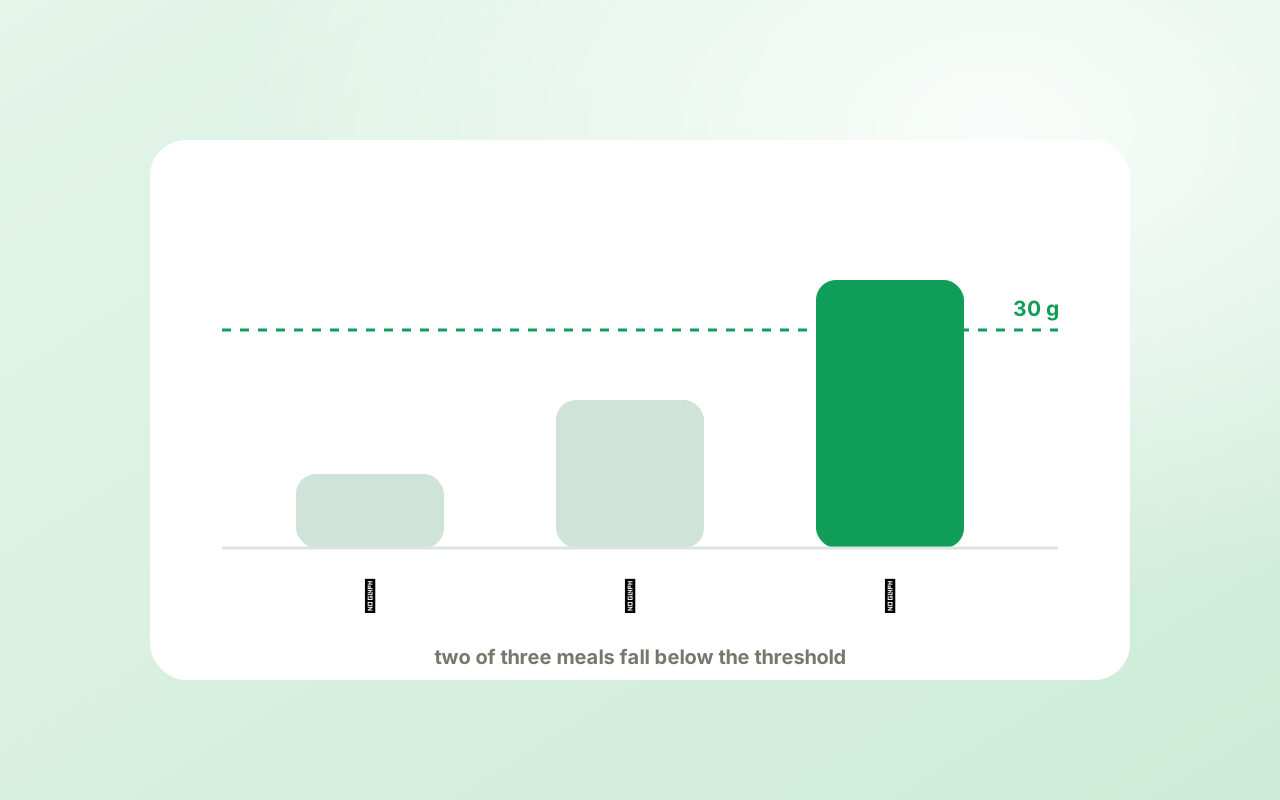
If you need to hit 1,847 kcal exactly for a clinical protocol, weigh your food and use a database. If you want to know that your lunches are heavy on fast carbs, that you are 30 g short on protein most days, and that weekend sugar is double your weekday average — a photo estimate with a short description is more than enough, and it is the only method most people will actually keep doing past week two.
The most accurate tracker is the one you still use in month three.
FAQ
Is AI calorie counting accurate enough for weight loss? Yes. Weight loss depends on a consistent deficit over weeks. Random errors of 15–25% per meal largely average out; what matters is logging every meal, and photo logging makes that far more likely than manual entry.
Which AI calorie app is the most accurate? There is no independent head-to-head that includes every app. Across benchmarks, apps that combine photo with barcode and text input, and that let you correct quickly, beat photo-only apps. Manual weighing plus barcode beats everything, at the cost of most people quitting.
Does adding a description really help? Yes — published research found error dropping from ~30% to ~14% with a short ingredient description. It is the single highest-value habit for photo logging.
Why does the app get restaurant food wrong? Restaurant dishes carry hidden oil, butter and sugar that the camera cannot see, and portions are larger than they look. Expect underestimation and add a note like "restaurant, likely oily."
Can AI count calories from a video? Yes. Video gives the model multiple angles, which improves portion estimation. CalMePlease supports short video clips as an input.
Related: Best AI calorie tracker apps in 2026 · CalMePlease vs Cal AI
CalMePlease logs meals by photo, video, voice or barcode and tracks ten metrics per meal. Free on the App Store.