Voice Food Logging: How to Track Meals Without Typing (and Which Apps Do It Well)
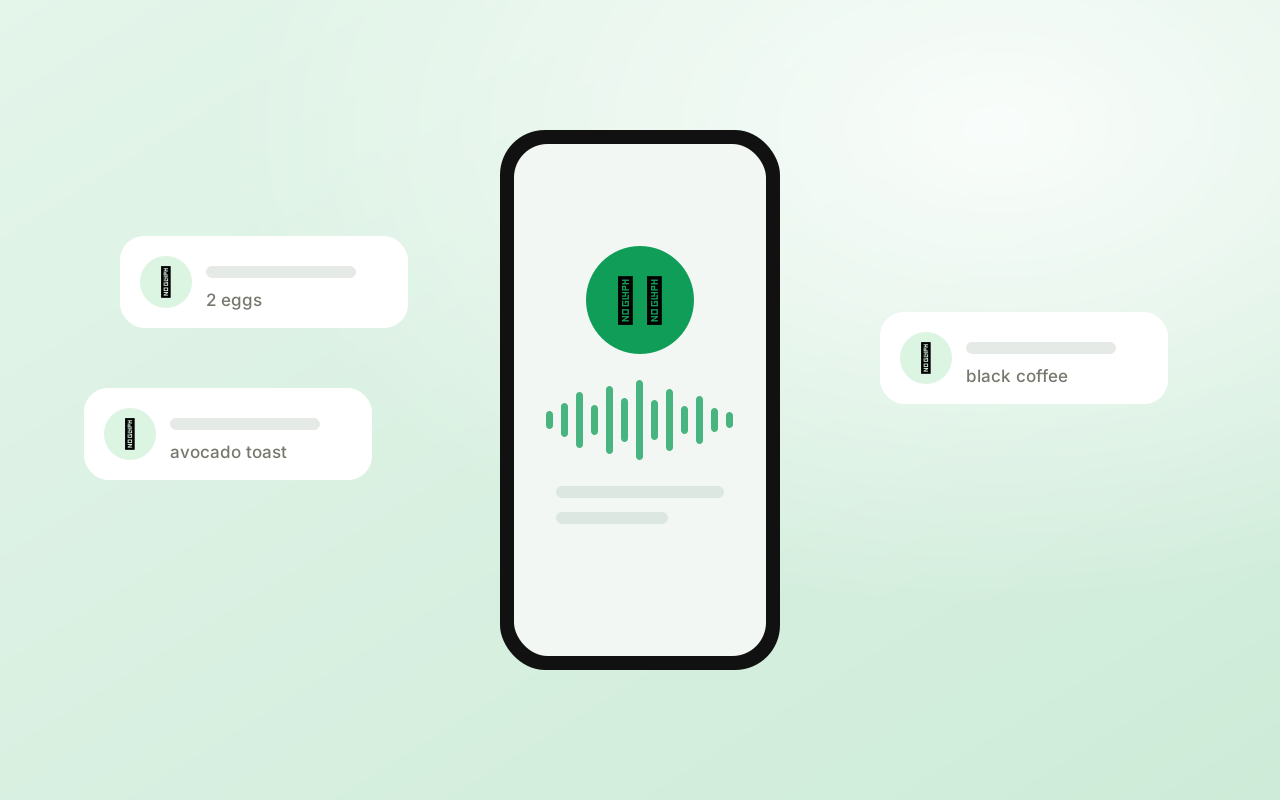
Quick answer: Voice logging means saying "two eggs, avocado toast and a black coffee" and having the app turn that into a logged meal with calories and macros. It is the fastest input for anyone who eats on their feet, in the car, or with one hand — and, because you state the food and often the amount, it tends to be more accurate than a photo alone. In 2026 it is supported natively by CalMePlease (nine languages), by Cal AI, and by MyFitnessPal on Premium; Yazio, Cronometer and Lose It! do not have it.
Why voice exists at all
Every tracking method fails for a specific person:
- Database search fails for anyone who cooks. Four searches per plate, every plate.
- Photo fails when there is no plate to photograph — a handful of nuts at the desk, a sandwich in the car, three bites of a child's leftovers — or when there is no time to frame the shot.
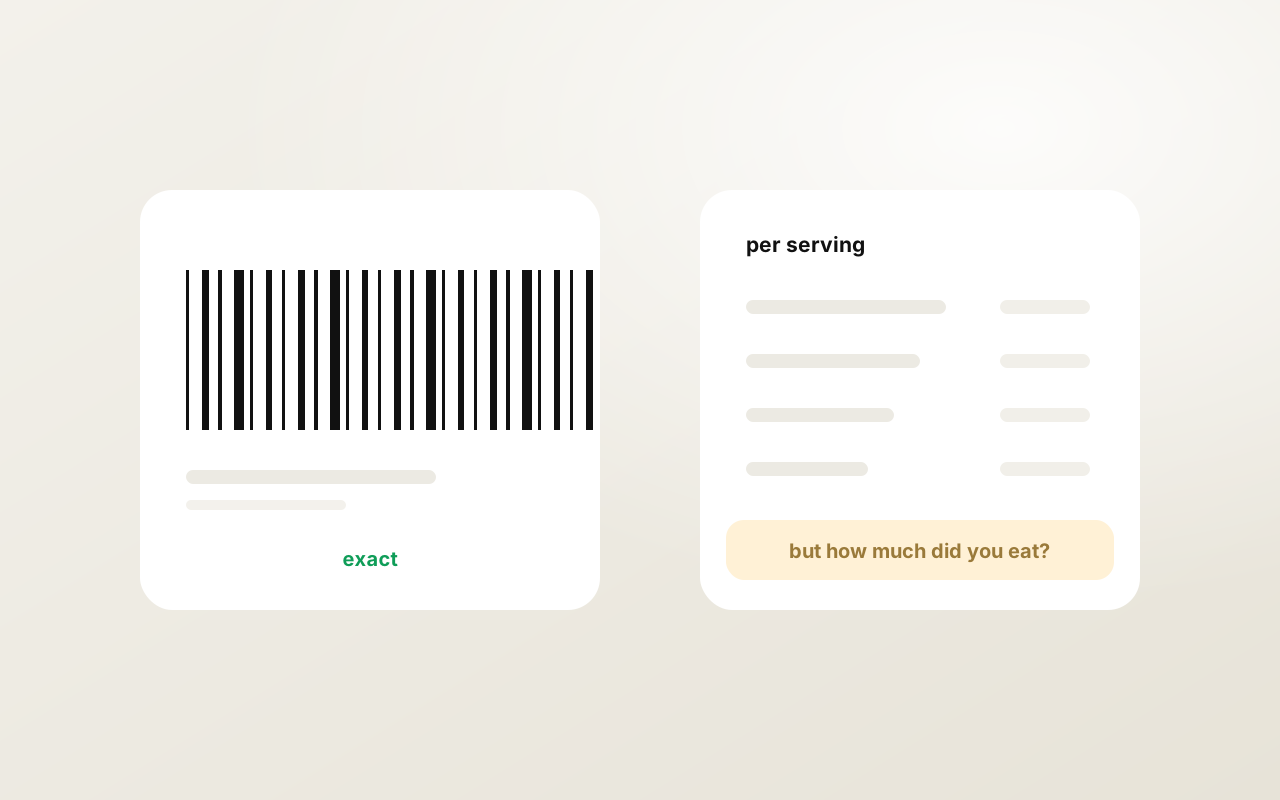
- Barcode fails for everything that is not packaged.
Voice fills the gap left by all three. It takes two seconds, works without looking at the screen, and captures the things people most often skip: snacks, drinks, and meals eaten while doing something else. Skipped meals are the main reason calorie logs undercount, so an input that catches them changes the accuracy of the whole week more than any improvement in photo recognition.
How voice food logging works
The pipeline has three stages:
- Speech to text. Your sentence is transcribed. Modern on-device and server models handle accents, background noise and food words well in major languages.
- Parsing. The model splits the sentence into items and quantities: "two eggs" → egg × 2; "avocado toast" → bread + avocado; "a large latte" → milk + espresso, large. Vague amounts ("some rice") are mapped to a default portion; explicit amounts ("about 150 g of chicken") are used as stated.
- Nutrient lookup. Each item and amount is matched to a nutrition database and the meal is logged with calories, macros and — in apps that track them — fiber, sugar and salt.
Because you name the food, step 2 of photo recognition (classification) is solved outright. Because you often state the amount, step 3 (portion) is solved too. The remaining error is the database entry and your own estimate of the amount — the same as manual logging, at a fraction of the effort.
Where voice beats photo and barcode
Snacks and drinks. "A handful of almonds and a flat white" is a five-word log. Photographing a handful of almonds is silly; nobody does it.
Eating away from the plate. Driving, walking, at a desk, at a party. Voice does not need the food in front of you.
Mixed and home-cooked dishes. "Chicken curry with cream, a cup of rice, a naan" gives the app the components a photo cannot see — the cream, the oil. Combined with a photo, this is the most accurate non-scale method there is.
Restaurant food. "Restaurant pad thai, large, with peanuts" tells the app to expect oil and sugar that the picture hides.
Accessibility. For anyone with limited vision or dexterity, voice is the only input that works reliably.
Where photo still wins
A photo is better when you genuinely do not know what you are eating — a buffet, an unfamiliar dish, a plate someone else assembled. It is also better for portion size when you have no sense of grams. The ideal is not one or the other: photograph the plate, then say what the camera cannot see.
The language problem
Most voice logging is English-first. Speak German or Korean and the app either fails or routes your words through a translation layer before parsing, which is where "Quark" becomes "curd" becomes the wrong database entry, or "김치찌개" becomes "kimchi stew" with a generic Western nutrition profile.
CalMePlease processes voice natively in nine languages — English, German, French, Spanish, Italian, Chinese, Korean, Japanese and Russian — with no translation between you and the log. The parsed items keep their regional identity and portions. If you eat in one of these languages, this is the feature to test first.
Which apps support voice logging in 2026
| App | Voice logging | Languages | Free tier |
|---|---|---|---|
| CalMePlease | Yes | 9, native | Yes |
| Cal AI | Yes | English-first | Paid (with AI scan) |
| MyFitnessPal | Voice Log | English-first | Premium only |
| Yazio | No | — | — |
| Cronometer | No | — | — |
| Lose It! | No | — | — |
| MacroFactor | Yes | English-first | Subscription only |
How to log by voice well
Six habits that make voice logs accurate:
- Name the food, then the amount. "Chicken breast, about 150 grams." Amount is what the app cannot guess.
- Mention the invisible things. Oil, butter, cream, dressing, sugar in coffee. These are the 100–300 kcal every method misses.
- Say the brand for packaged food — or better, scan the barcode instead.
- Use your own units. "A cup", "a handful", "a slice" are fine; the app has defaults. Grams are better if you know them.
- Log right after eating, not at the end of the day. Recall accuracy drops fast.
- Check the result once. If the app heard "toast" and you said "roast", fix it. It takes one tap.
Voice as the input that survives
The tracker that helps you is the one you are still using in month three. Photo is fast; voice is faster and works in the moments photo does not. For the people who quit every tracker they try — because logging always ended up being a chore at 9 pm — voice is often the input that finally makes it stick.
FAQ
Can I log food by talking to Siri? Some apps expose Siri Shortcuts for basic entries, but full voice parsing with quantities happens inside the app. In CalMePlease, tap the microphone and speak.
Is voice logging accurate? More accurate than photo alone for known foods, because you state what and how much. Less accurate than a barcode for packaged products. The remaining error is your amount estimate and the database entry.
Does voice logging work in German / Spanish / Japanese? In CalMePlease, yes, natively in nine languages. Most other apps parse English best and rely on translation for the rest.
Does voice logging work offline? Transcription may work offline on newer phones; nutrient lookup and AI parsing typically require a connection.
Can I log a whole day by voice? Yes: "breakfast was oats with a banana, lunch a chicken salad, dinner salmon with rice." The app splits it into meals. Same-day logging is more accurate than reconstructing the day later.
Related: How AI food recognition works · Barcode scanner for calories: what the label doesn't tell you
CalMePlease logs meals by voice in nine languages, plus photo, video and barcode. Free on the App Store.