How AI Food Recognition Works: From a Photo to Calories and Macros
Quick answer: When you photograph a plate, the app runs four steps in sequence — it separates the food from the background, identifies each item, estimates how much of each is there, and looks up the nutrition for that amount. The first two steps are now very reliable; the third, portion estimation from a flat image, is where most of the error lives; and the fourth depends entirely on the quality of the database behind the app. Adding a few words of context ("chicken breast, about 150 g, with rice") roughly halves the final error because it fixes steps two and three at once.
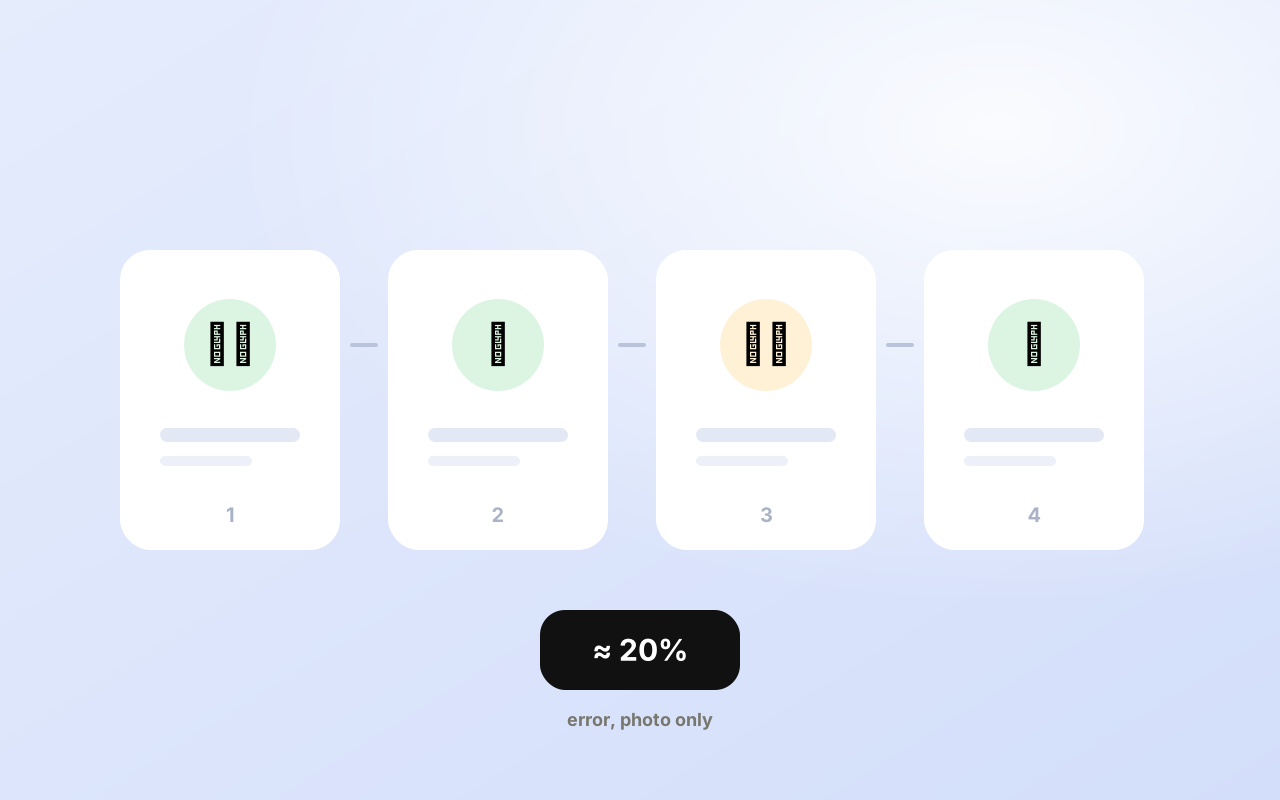
Why this is harder than it looks
A human glancing at a plate does the same four things unconsciously and gets it wrong most of the time — in one study of 2,000 people, the average person guessed calories within 20% only 5 times out of 20. Trained annotators did no better. The problem is not intelligence; it is that a single image genuinely does not contain enough information. Depth, density, hidden oil and sauce, and the difference between full-fat and low-fat anything are invisible to a camera.
AI food recognition does not solve that. It makes the guess faster, more consistent and easier to correct.
Step 1: Segmentation — finding the food
The model first divides the image into regions: plate, table, hands, and each distinct food item. Modern segmentation models handle this well even with overlapping foods, but they lose accuracy when items are mixed rather than adjacent — a stew, a curry, a burrito with everything inside. If the model cannot draw a boundary around the rice, it cannot measure the rice.
What breaks it: low light, motion blur, food photographed at a steep angle, and dishes where components are blended.
Step 2: Classification — naming what it found
Each region is matched against a model trained on millions of labelled food images. For common foods — grilled chicken, white rice, broccoli, a fried egg — accuracy is high. Errors cluster around look-alikes:
- chicken thigh vs breast (different fat content)
- white rice vs risotto vs cauliflower rice
- full-fat vs low-fat yogurt
- butter vs margarine vs olive oil spread
- sweetened vs unsweetened drinks
- regional dishes the model has seen less of
Most apps in 2026 run this step on a large multimodal model rather than a food-specific classifier, which improved coverage of unusual and regional dishes but did not fix the look-alike problem — the model still cannot see fat content.
What breaks it: visually similar foods, unusual cuisines, food hidden under sauce or garnish.
Step 3: Portion estimation — how much is there
This is the hard part and the main source of error. The model has to infer three-dimensional volume from a two-dimensional image with no reference scale. It uses cues — plate size, fork, hand, typical serving shapes — but a bowl of rice looks the same from above whether it holds 150 g or 300 g.
Research on portion estimation consistently shows this step contributing the largest share of error. In one crowdsourcing study, adding a reference object like a credit card actually made human estimates worse, which tells you how counterintuitive volume is.
Two things help:
- Video instead of a single photo. A two-second pan gives the model multiple angles and lets it reason about depth. CalMePlease supports video input for exactly this reason.
- A stated amount. "About a cup" or "150 g" removes the guess entirely.
What breaks it: deep bowls, stacked food, anything viewed straight down, portions larger than the model expects.
Step 4: Nutrient lookup — turning food and amount into numbers
The identified food and estimated weight are matched to a nutrition database and multiplied out into calories, protein, carbs, fat and — in apps that track them — fiber, sugar, salt and more.
This step is only as good as the database. "Chicken curry" maps to wildly different entries depending on cream, oil and sugar. A crowdsourced database has entries that are wrong; a curated one has entries that are missing. The best apps use a verified base and let the model adjust for what it sees (oily, creamy, dry).
What breaks it: generic entries for dishes with high variance, restaurant food with hidden fat and sugar, packaged products that should have been scanned instead.
How errors compound
Each step passes its error to the next. A 10% miss on portion, a look-alike swap that changes fat by 30%, and a generic database entry can produce a final number 30–40% off — which is why two apps can look at the same plate and disagree by a third.
Published figures for the full pipeline: roughly 15–30% mean error for photo-only estimation on real meals, dropping to about 14% when the user adds a short description. Single simple foods sit at the low end; mixed dishes at the high end.
Why a sentence of context matters so much
A short text or voice note fixes the two worst steps in one move:
- "chicken breast" resolves the classification (breast, not thigh)
- "about 150 g" resolves the portion
- "with olive oil" adds the invisible fat
The photo still does the work of identifying everything on the plate; the sentence corrects the two things the photo cannot see. This is why CalMePlease is built around photo plus a voice note in your own language, rather than photo alone. The research says that combination is the practical ceiling for accuracy without a scale.
Beyond the number: what the app does with it
Recognition ends at step four. What happens next is where apps diverge.
Most trackers add the calories to a daily total and stop. CalMePlease feeds all ten metrics — including fiber, sugar and salt, which most photo apps skip — into an AI coach that reads the day as a whole and tells you what to eat next. The recognition pipeline is the input; the coaching is the product. An estimate that is 20% off but leads to "you are low on protein, add some at dinner" is more useful than a perfect number nobody acts on.
Can recognition be done on the device?
Some apps now run parts of the pipeline on-device using Apple's on-device models, which means the photo never leaves the phone. As of 2026 the trade-off is accuracy: on-device models are smaller and handle unusual foods worse. Most apps, including CalMePlease, process the image on a server and store the resulting history locally. What matters for privacy is what is retained: CalMePlease keeps meal history, weight and statistics on your device and does not sell or share data.
FAQ
How does an app know how many calories are in my food from a photo? It identifies each food, estimates its weight from the image, and looks up calories per gram in a database. All three are estimates; the weight is the least reliable.
Why do two apps give different calories for the same photo? Different classification models, different portion heuristics and different databases. Errors at each step add up.
Does AI food recognition work for home-cooked meals? Yes, better than a database search does — the AI names components you would otherwise have to find one by one. Add a note about oil or sauce for a closer number.
Can AI recognise food from a video? Yes. Video gives multiple angles, which improves portion estimation. CalMePlease accepts short clips as input.
Is AI food recognition accurate enough for weight loss? For consistent logging, yes. Random errors average out over a week; what matters is logging every meal and correcting obvious misses. See How accurate is AI calorie counting by photo?
Related: Voice food logging: how to track meals without typing · Barcode scanner for calories: what the label doesn't tell you
CalMePlease logs meals by photo, video, voice or barcode and tracks ten metrics per meal. Free on the App Store.