16:8 Intermittent Fasting: How It Works, Calories, Macros and Who It Suits
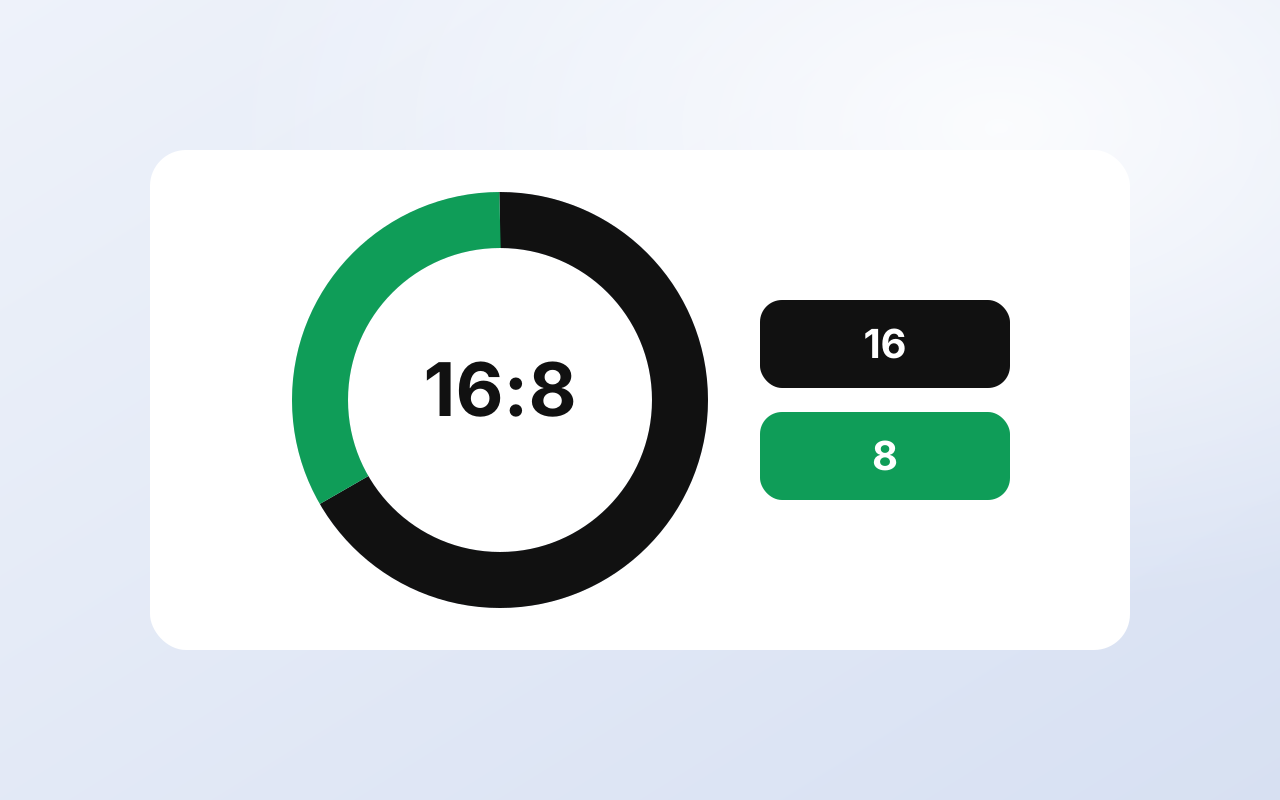
Quick answer: 16:8 intermittent fasting means you eat all your food inside an 8-hour window, for example 12:00 to 20:00, and have only water or zero-calorie drinks for the other 16 hours. The honest bottom line from randomized trials: it works about as well as ordinary calorie restriction, not better. In a 12-month trial of 90 adults with obesity, an 8-hour window without calorie counting lost a similar amount of weight to a 25% calorie cut. When both groups ate the same calories, adding the eating window gave no significant extra loss. 16:8 is a way to eat less that some people find easier. It has no fat-burning effect beyond that.
How it works
You pick an 8-hour window and eat only inside it. Outside the window you drink water, black coffee or plain tea. The window can sit anywhere in the day. The best one is the one you can keep on workdays, weekends and at social dinners.
| Window | First meal | Last meal | Fits |
|---|---|---|---|
| 08:00–16:00 | 08:00 | before 16:00 | Early risers; the window used in the Liu et al. 2022 trial |
| 10:00–18:00 | 10:00 | before 18:00 | People who eat an early family dinner |
| 12:00–20:00 | 12:00 | before 20:00 | The most common choice: you skip breakfast and keep dinner. Used in the Lowe et al. 2020 and Lin et al. 2023 trials |
| 13:00–21:00 | 13:00 | before 21:00 | Late schedules and evening social meals |
The 16 hours include sleep: if you sleep 8 hours, only 8 of the fasting hours are spent awake. Johns Hopkins Medicine notes it can take two to four weeks for the body to get used to intermittent fasting. Hunger and irritability are common at first.
What the research says
Three randomized trials are the most useful here. Each tested an 8-hour window (16:8) for at least 12 weeks.
| Study | Who and how long | What was compared | Result |
|---|---|---|---|
| Lowe et al., 2020, JAMA Internal Medicine (TREAT trial) | 116 adults with overweight or obesity, 12 weeks | Eating freely from 12:00 to 20:00 vs three structured meals a day | −0.94 kg vs −0.68 kg; the difference between the groups was not significant |
| Liu et al., 2022, New England Journal of Medicine | 139 adults with obesity, 12 months | Both groups calorie-restricted (1,500–1,800 kcal men, 1,200–1,500 kcal women); one group also ate only 08:00–16:00 | −8.0 kg vs −6.3 kg; the difference was not significant |
| Lin et al., 2023, Annals of Internal Medicine | 90 adults with obesity, 12 months | Eating 12:00–20:00 without counting calories vs cutting calories by 25% vs no change | Compared with the no-change group: −4.6 kg with the eating window, −5.4 kg with the calorie cut; the two diets did not differ significantly |
What this means in practice:
- On its own, the clock does little. In the TREAT trial, people who only changed when they ate lost no more than people eating three meals a day. The authors concluded that time-restricted eating alone "is not more effective in weight loss than eating throughout the day."
- Calories explain the weight loss. In the Lin trial, the eating-window group ate about 425 kcal a day less than the control group, and the calorie-cut group about 405 kcal less. The weight loss followed the calories.
- When calories are equal, the window adds no proven benefit. In the Liu trial, both groups ate the same calorie target. The eating-window group lost 1.8 kg more on average, but the difference was not statistically significant.
- It is a reasonable option, not a superior one. The editorial with the Lin trial called the effects "comparable to those of traditional caloric restriction diets," and said patient preference can guide the choice.
These trials were in adults with overweight or obesity. They do not show what 16:8 does for people at a healthy weight, and none of them lasted longer than a year.
Calories and macros inside the window
16:8 works when it creates a calorie deficit. The window only makes the deficit easier for some people, because there is less time to eat. As Johns Hopkins puts it, research shows "you're not likely to lose weight or get healthier if you pack your feeding times with high-calorie food."
So the numbers inside the window are the same as for any diet:
- Calories: maintenance minus 300–500 kcal. How to find your own number: How to calculate a calorie deficit.
- Protein: the protein target does not shrink because the window did. With fewer meals, each one has to carry a bigger share of it. How much protein per day.
- Macros: 16:8 sets a time, not a macro split. Any balance you can keep, whether higher-carb, lower-carb or in between, works the same way.
- Fiber and volume: with fewer meals, each meal has to keep you full for longer. Vegetables, beans and whole grains make the hours before the window opens easier. How much fiber per day.
A sample 12:00–20:00 day:
| Time | Meal | What it is built around |
|---|---|---|
| Before 12:00 | Water, black coffee or plain tea | Zero calories, so the fast stays a fast |
| 12:00 | First meal: eggs, wholegrain bread, fruit | Protein early, so the first hours of eating do not turn into grazing |
| 16:00 | Snack: Greek yogurt and berries | Protein and fiber to bridge to dinner |
| 19:30 | Last meal: fish, chicken or beans, rice or potatoes, a large portion of vegetables | The biggest protein serving of the day, finished before 20:00 |
For calories and protein per portion, see calories in eggs, calories in bread and calories in rice. Milk and sugar in coffee count as food: calories in coffee drinks.
Who it suits and who should not do it
It tends to suit people who:
- are not hungry in the morning and already skip breakfast;
- snack in the evening, so a fixed end time removes the snacking;
- find a clock rule easier to follow than a calorie number.
It tends not to suit people who:
- get very hungry in the morning and make up for it with a large dinner;
- train early and need food around the session;
- have family or work meals that regularly fall outside any fixed window.
Who should not try it. Johns Hopkins Medicine says intermittent fasting "isn't for everyone, so talk to your doctor before you consider starting," and it lists these groups as people who should not try it:
- children and teens under 18;
- women who are pregnant or breastfeeding;
- people with type 1 diabetes who take insulin, because of the risk of low blood sugar;
- people with a history of eating disorders.
A Mayo Clinic cardiologist writes that intermittent fasting "is particularly unsafe for patients with heart disease or with a history of heart disease," and that it can be safer with supervision from your healthcare team. If you take regular medication or have a long-term condition, check with your doctor first. Johns Hopkins also advises talking to a doctor about unusual anxiety, headaches, nausea or other symptoms that start after you begin fasting.
How to track 16:8 in CalMePlease
CalMePlease is a food tracker, not a fasting timer. It counts what you eat and drink inside the window. Set the window itself with a phone alarm or calendar reminder. Then:
- Set your goal. The app sets your daily calorie and macro targets from it and recalculates them as your weight and activity change. The window does not change the target. It changes when you eat it.
- Log each meal as you eat it. Use a photo, a short video, a voice note, a barcode scan or typed text. Two meals and a snack take three logs a day.
- Watch protein before the last meal. The AI coach answers between meals. If you are short on protein at 17:00, it will say so before dinner, while you can still fix it.
- Log what you drink while fasting. Water counts toward your water total. If you add milk or sugar to a morning coffee, log it: it is food, and it also breaks the fast.
- Forgot a meal? Pick the past day in the calendar and add it there. The daily totals and the weekly report recalculate automatically.
The fasting itself needs no tracking: it is 16 hours of nothing. The deficit happens inside the 8-hour window, and that is the part to track.
FAQ
Can I drink coffee while fasting on 16:8? Yes. Black coffee, plain tea and water are zero-calorie and fit the fasting hours. Milk, sugar, syrups and creamers add calories, so drink them inside the window.
Does 16:8 work without counting calories? It can. In a 12-month trial, people who ate only between 12:00 and 20:00 without counting calories lost a similar amount of weight to people who cut calories by 25%. They lost weight because they ate about 425 kcal a day less. If the window does not reduce what you eat, the scale will not move.
Is 16:8 better than regular calorie restriction? Trials so far say no. In two 12-month trials, an 8-hour window and plain calorie restriction produced similar weight loss, and the differences between them were not statistically significant. Choose whichever you can keep up.
How long does it take to get used to 16:8? Johns Hopkins Medicine notes it can take two to four weeks for the body to adjust to intermittent fasting. Hunger and irritability are common at first.
Is 16:8 safe? Johns Hopkins Medicine advises talking to your doctor before you start, and says it is not for children and teens, people who are pregnant or breastfeeding, people with type 1 diabetes on insulin, or anyone with a history of eating disorders. People with heart disease should talk to their doctor first. If you have any medical condition, check with your doctor before starting.
This article is general information, not medical advice. If you have a medical condition, take regular medication, are pregnant, or have a history of disordered eating, talk to a doctor or registered dietitian before starting intermittent fasting.
Data: Lowe DA et al., JAMA Internal Medicine 2020;180(11) (TREAT trial); Liu D et al., N Engl J Med 2022;386(16):1495–1504; Lin S et al., Annals of Internal Medicine 2023, as summarized by ACP Internist; Johns Hopkins Medicine, Intermittent Fasting: What is it, and how does it work?; Mayo Clinic News Network, Is intermittent fasting a helpful practice or health risk? (April 2025). Checked October 2026.
Related: How to calculate a calorie deficit · How much protein per day · Is calorie counting bad?
CalMePlease logs every meal in your window from a photo, voice note or barcode and keeps calories and protein in view before the window closes. Free on the App Store.