Weight Loss Plateau: Why It Happens and What to Change
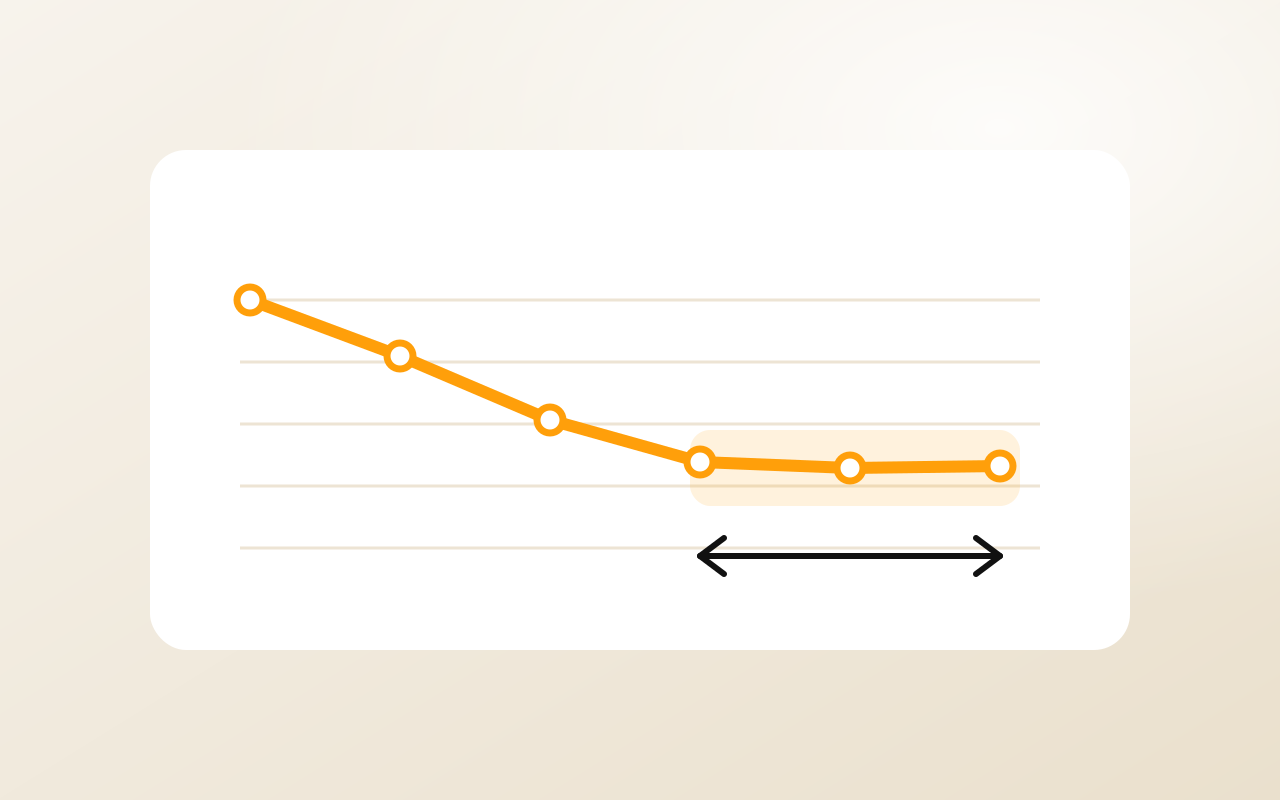
Quick answer: A weight loss plateau is when your weekly average weight stops falling for several weeks even though you think you're following the same plan. It's normal: in a review of 80 weight-loss trials, weight loss typically leveled off at about 6 months. Three things cause it. Your body needs fewer calories at a lower weight, appetite pushes you to eat more, and small extras slip out of your log. The fix is to confirm the stall with weekly averages, check your log for a week, and then recalculate your calories for your new weight.
Is it really a plateau?
Daily weight moves up and down with water, salt, carbs and the food still in your gut. Early in a diet, part of the fast drop is water. Your body burns stored glycogen, and the water stored with it is released too. That's why the first weeks look faster than the later ones, and why a single high reading tells you very little. How much water per day →
Before you change anything, check the pattern:
| What you see | What it usually means | What to do |
|---|---|---|
| One or two high days after a salty or carb-heavy meal | Water, not fat | Nothing. Keep going |
| Weekly average flat for 1–2 weeks | Normal noise | Keep going and keep logging |
| Weekly average flat for 3 weeks or more, with honest logging | A real plateau | Work through the steps below |
| Weight slowly climbing back for a month | Intake has crept above your new needs | Audit your log first |
Weigh yourself on the same scale, at the same time, under the same conditions, at least three times a week. Compare the average of each week with the week before, not one morning with another. The three-week threshold is our working rule, not a medical definition: it's long enough to see past most water swings.
Why weight loss stops: three reasons
1. A lighter body needs fewer calories
The deficit you set at the start shrinks as you lose weight. A smaller body burns fewer calories at rest and during movement, so the same daily intake gives a smaller and smaller gap.
Here is an example using the Mifflin-St Jeor equation (the same method as in how to calculate your calorie deficit). She's a 35-year-old woman, 165 cm (5 ft 5 in) tall and lightly active (factor 1.375). She starts at 85 kg (187 lb) and eats 1,625 kcal a day, a 500 kcal deficit at her starting weight. She never changes her plan.
| Weight | Resting rate | Daily needs | Deficit at 1,625 kcal | Expected loss per week |
|---|---|---|---|---|
| 85 kg (187 lb) | 1,545 kcal | 2,125 kcal | 500 kcal | about 1.0 lb |
| 80 kg (176 lb) | 1,495 kcal | 2,055 kcal | 430 kcal | about 0.9 lb |
| 75 kg (165 lb) | 1,445 kcal | 1,985 kcal | 360 kcal | about 0.7 lb |
| 70 kg (154 lb) | 1,395 kcal | 1,920 kcal | 295 kcal | about 0.6 lb |
Resting rate = 10 × weight in kg + 6.25 × height in cm − 5 × age − 161. At 85 kg: 850 + 1,031 − 175 − 161 = 1,545 kcal. Daily needs = resting rate × 1.375. Weekly loss = deficit × 7 / 3,500 kcal per pound.
After 15 kg, the same plan loses less than two-thirds as fast. And this is only the part a formula can predict. Research by Kevin Hall's group at the NIH estimates that each 10 kcal a day you cut leads to about 1 pound of loss over roughly 3 years, with half of it in the first year (Hall et al., Lancet, 2011). The 3,500 kcal rule works for a few weeks, but over months it overstates the loss because the body adapts.
The body can also burn less than a formula expects. In a study of 14 former contestants of The Biggest Loser, resting metabolism was still about 500 kcal a day lower than predicted for their size six years after the show (Fothergill et al., Obesity, 2016). That was an extreme case: they had lost an average of 58 kg in 30 weeks. For an ordinary diet, the adaptation is smaller, but it pushes in the same direction.
2. Appetite rises as you lose weight
The body defends its weight through hunger as well as through metabolism. In a year-long trial of 153 people with type 2 diabetes taking canagliflozin, a drug that makes the body lose calories through the urine, appetite rose by about 100 kcal a day for each kilogram lost. That was more than three times the drop in energy expenditure (Polidori et al., Obesity, 2016).
This is the main reason plateaus feel mysterious. Nobody decides to eat 300 kcal more. Portions get a little bigger, snacks come back, and the log looks the same.
3. Small extras slip out of the log
Underreporting is a frequent reason a plateau looks "impossible". In a study in The New England Journal of Medicine, people with obesity who said they couldn't lose weight on under 1,200 kcal a day were measured with doubly labeled water. On average they underreported what they ate by 47% and overreported their exercise by 51% (Lichtman et al., N Engl J Med, 1992). They weren't lying. Estimating food by eye is hard, and the misses are almost always in the same direction.
The usual misses are small things that don't feel like food:
| Often left out | Portion | kcal |
|---|---|---|
| Olive oil in the pan (04053) | 1 tbsp, 13.5 g | 120 |
| Butter on toast (01001) | 1 tbsp, 14.2 g | 100 |
| Half-and-half in coffee (01049) | 2 tbsp, 30 g | 37 |
| Sugar in coffee (19335) | 2 tsp, 8.4 g | 33 |
| Handful of almonds (12061) | 1 oz, 28 g | 165 |
| Mayonnaise in a sandwich (04025) | 1 tbsp, 13.8 g | 94 |
| Peanut butter "tasted" from the jar (16098) | 1 tbsp, 16 g | 96 |
| Total | about 645 |
That's more than the whole 500 kcal deficit from the example above. You don't need all seven: any three of these a day can quietly cancel most of a deficit that has already shrunk to 300–400 kcal.
What to change, in order
1. Confirm it. Three or more weeks of flat weekly averages. If it's less, keep going.
2. Audit one week of logging. For seven days, log everything as you eat it, including oil, drinks, sauces and tastes while cooking. Weigh the foods you eat most often at least once, so your usual portion has a number. Compare the week with your earlier logs: often the plateau is right there.
3. Recalculate your needs for your current weight. Use the same formula with today's weight. Set your new target 300–500 kcal below that. If the new number would take you under 1,200 kcal a day, don't cut further without medical advice: very low intakes make hunger and overeating more likely (Mayo Clinic). Increase activity instead.
4. Move more, and count it honestly. Extra daily steps raise the "needs" side of the equation. Count a realistic number, not the highest one your watch shows. Calories burned by 10,000 steps →
5. Make the smaller target easier to eat. Fill the plate with high-volume, low-calorie foods and keep protein high, so the lower number doesn't feel like a fight with hunger. High-volume low-calorie foods → · High-protein foods →
6. Give each change three weeks. Then check the weekly averages again. Change one thing at a time, so you know what worked.
If you've lost a large amount of weight, the new "maintenance" number may simply be where you are now. Holding a lower weight is a result in itself. In the same review, trials that followed people for four years found that they still kept off 3–6 kg on average (Franz et al., J Am Diet Assoc, 2007).
When to talk to a doctor
If your weight hasn't changed for several months despite a careful log and a recalculated target, talk to your doctor. Some medications and medical conditions affect weight and appetite. The same applies if you're pregnant, breastfeeding, have diabetes or another condition, or are thinking about eating under 1,200 kcal a day: follow your doctor's advice.
How to log through a plateau
During a plateau, a complete log is more useful than a perfect one. Log as you eat, not at the end of the day, and include the extras from the table above. Say it as you'd say it to a friend: "two eggs fried in a tablespoon of olive oil and a slice of toast with butter". CalMePlease turns a voice note or a few words of text into separate entries with calories and macros, and shows the estimated weight in grams. If it's off, you can correct it in one tap. If you forgot a meal, you can add it to any past day from the calendar. Voice food logging →
For packaged food, scan the barcode: the pack's serving size is kept, so a "small bag" isn't guessed. Steps and workouts come from Apple Health, so the activity side of the day is in the same place as the food.
FAQ
How long does a weight loss plateau last? As long as the gap between what you eat and what you burn stays at zero. Without changes, it can last indefinitely: that's simply your maintenance level for the current plan. After you adjust, give it three weeks before judging the result.
Why am I not losing weight on 1,200 calories? Often, real intake is higher than the log shows. In one well-known study, people who reported eating under 1,200 kcal underreported by 47% on average. Weigh your usual foods for a week and log oils and drinks. If the scale still doesn't move after a careful month, talk to your doctor.
Is my metabolism broken? No. It's lower because you're smaller, and it may be somewhat lower than a formula predicts. Even in the extreme Biggest Loser study, it was about 500 kcal a day below prediction. A lower target or more activity can still create a deficit.
Should I eat more to break a plateau? There's no good evidence that eating more restarts weight loss by "boosting" metabolism. If you need a pause, eat at your recalculated maintenance level: it holds your weight steady, but it doesn't make you burn more.
Does muscle gain hide fat loss? It can if you've started strength training. If your waist or the fit of your clothes is getting smaller while the scale is flat, you're likely still losing fat. Measure your waist once a week alongside your weight.
How often should I weigh myself during a plateau? At least three times a week, at the same time of day, and compare weekly averages. Daily weighing works too, as long as you look at the average and not at single days.
Data: Franz MJ et al., Weight-loss outcomes: a systematic review and meta-analysis of weight-loss clinical trials with a minimum 1-year follow-up, J Am Diet Assoc 2007;107:1755–1767; Hall KD et al., Quantification of the effect of energy imbalance on bodyweight, Lancet 2011;378:826–837; Fothergill E et al., Persistent metabolic adaptation 6 years after "The Biggest Loser" competition, Obesity 2016;24:1612–1619; Polidori D et al., How strongly does appetite counter weight loss? Quantification of the feedback control of human energy intake, Obesity 2016;24:2289–2295; Lichtman SW et al., Discrepancy between self-reported and actual caloric intake and exercise in obese subjects, N Engl J Med 1992;327:1893–1898; Mifflin MD, St Jeor ST et al., A new predictive equation for resting energy expenditure in healthy individuals, Am J Clin Nutr 1990;51:241–247; Mayo Clinic, Getting past a weight-loss plateau. Food values: USDA FoodData Central, SR Legacy, by NDB number. Values checked October 2026.
Related: How to calculate your calorie deficit · Lose holiday weight in January · High-volume low-calorie foods · How to build a food tracking habit
CalMePlease logs every meal, including the oil and the coffee cream, from a voice note, a few words of text, a photo or a barcode, and shows calories and macros for the whole day. Free on the App Store.