How to Calculate Your Macros for Weight Loss (With Two Sample Days)
Quick answer: Set your calories first, because the calorie deficit drives weight loss, not the macro ratio. Then set protein at 1.2–1.6 g per kg of body weight, fat at 20–35% of calories, and give carbs whatever is left. For a 35-year-old woman at 85 kg eating 1,625 kcal, that's about 120 g protein, 45 g fat and 185 g carbs. Within those ranges, the exact split matters much less than hitting your calories day after day: in a year-long trial of 609 adults, a healthy low-fat diet and a healthy low-carb diet led to almost the same weight loss.
Step 1: Set your calories
Macros divide up a calorie budget, so the budget comes first. Estimate your maintenance calories with the Mifflin-St Jeor equation, multiply by an activity factor, and subtract 300–500 kcal. The full method is in how to calculate your calorie deficit. Here are the two people we'll use in this article:
| Woman | Man | |
|---|---|---|
| Age, height, weight | 35, 165 cm (5 ft 5 in), 85 kg (187 lb) | 40, 180 cm (5 ft 11 in), 95 kg (209 lb) |
| Resting rate (Mifflin-St Jeor) | 1,545 kcal | 1,880 kcal |
| Daily needs, lightly active (× 1.375) | 2,125 kcal | 2,585 kcal |
| Target with a 500 kcal deficit | 1,625 kcal | 2,085 kcal |
Resting rate for women = 10 × kg + 6.25 × cm − 5 × age − 161. For men, the last term is +5 instead of −161. Man: 950 + 1,125 − 200 + 5 = 1,880 kcal.
Step 2: Set protein
Protein is the macro worth fixing first: a higher intake helps you stay full and protect muscle while you're in a deficit. For weight loss, aim for 1.2–1.6 g per kg of body weight a day. Our examples use 1.4 g/kg, the middle of the range, rounded to the nearest 10 g:
- Woman: 85 kg × 1.4 = 119 → 120 g. 120 g × 4 kcal/g = 480 kcal, 30% of 1,625.
- Man: 95 kg × 1.4 = 133 → 130 g. 130 g × 4 = 520 kcal, 25% of 2,085.
If you have a lot of weight to lose, multiplying your current weight can give a number that's hard to eat. Base it on your goal weight instead. That's our working rule, not an official one. Why the range is 1.2–1.6 and not the official 0.8 is explained in how much protein per day.
Step 3: Set fat
The National Academies set the acceptable range for fat at 20–35% of calories for adults. The lower limit is there because very low-fat diets make it harder to get enough essential fatty acids and vitamin E. Our examples use 25%:
- Woman: 25% × 1,625 = 406 kcal ÷ 9 kcal/g = 45 g.
- Man: 25% × 2,085 = 521 kcal ÷ 9 = 58 g.
Step 4: Give carbs the rest
Carbs fill the remaining calories:
- Woman: (1,625 − 480 − 406) ÷ 4 = 185 g (45% of calories).
- Man: (2,085 − 520 − 521) ÷ 4 = 261 g (50%).
Both land inside the official range for carbs, 45–65% of calories. The National Academies also set a Recommended Dietary Allowance of 130 g of carbs a day, based on the glucose the brain uses. Both examples are well above it.
| Calories | Protein | Fat | Carbs | |
|---|---|---|---|---|
| Woman | 1,625 kcal | 120 g (30%) | 45 g (25%) | 185 g (45%) |
| Man | 2,085 kcal | 130 g (25%) | 58 g (25%) | 261 g (50%) |
Does the ratio matter?
Less than you might expect. Two large trials tested exactly this question:
- DIETFITS (Gardner et al., JAMA, 2018). 609 adults were randomly assigned to a healthy low-fat or a healthy low-carb diet for 12 months. Average loss was 5.3 kg on low-fat and 6.0 kg on low-carb, a difference that wasn't statistically significant.
- POUNDS Lost (Sacks et al., N Engl J Med, 2009). 811 adults followed one of four calorie-reduced diets with different shares of fat, protein and carbs. After two years, weight loss was similar in all four groups.
So choose the split you can stick to. Here are three versions of the same 1,625 kcal day with the same 120 g of protein:
| Split | Protein | Fat | Carbs | Who it suits |
|---|---|---|---|---|
| Lower fat | 120 g (30%) | 36 g (20%) | 205 g (50%) | People who like bread, rice, fruit and big portions |
| Balanced (our example) | 120 g (30%) | 45 g (25%) | 185 g (45%) | A default if you don't have a preference |
| Lower carb | 120 g (30%) | 63 g (35%) | 144 g (35%) | People who feel fuller with more fat and fewer starches |
Lower fat: 20% × 1,625 = 325 kcal ÷ 9 = 36 g; (1,625 − 480 − 325) ÷ 4 = 205 g. Lower carb: 35% × 1,625 = 569 kcal ÷ 9 = 63 g; (1,625 − 480 − 569) ÷ 4 = 144 g. The lower-carb version is below the official 45% for carbs but above the 130 g allowance. For a stricter low-carb diet, see your doctor first if you have diabetes or take medication for it.
Sample day: 1,625 kcal (120 g protein, 45 g fat, 185 g carbs)
| Meal | Food (USDA record) | Portion | kcal | Protein | Carbs | Fat |
|---|---|---|---|---|---|---|
| Breakfast | Oats, dry, cooked in water (08120) | ½ cup dry, 40 g | 152 | 5 g | 27 g | 3 g |
| Skim milk (01085) | 1 cup, 245 g | 83 | 8 g | 12 g | 0 g | |
| Blueberries (09050) | ½ cup, 74 g | 42 | 1 g | 11 g | 0 g | |
| Eggs, hard-boiled (01129) | 2 large, 100 g | 155 | 13 g | 1 g | 11 g | |
| Lunch | Chicken breast, roasted, no skin (05064) | 120 g | 198 | 37 g | 0 g | 4 g |
| White rice, cooked (20045) | 1 cup, 158 g | 205 | 4 g | 45 g | 0 g | |
| Broccoli, boiled (11091) | 1 cup, 156 g | 55 | 4 g | 11 g | 1 g | |
| Olive oil (04053) | ½ tbsp, 6.75 g | 60 | 0 g | 0 g | 7 g | |
| Snack | Greek yogurt, plain, nonfat (01256) | 1 container, 170 g | 100 | 17 g | 6 g | 1 g |
| Apple, with skin (09003) | 1 medium, 182 g | 95 | 0 g | 25 g | 0 g | |
| Dinner | Atlantic salmon, wild, cooked (15209) | 4 oz, 113 g | 206 | 29 g | 0 g | 9 g |
| Baked potato, with skin (11674) | 1 medium, 173 g | 161 | 4 g | 37 g | 0 g | |
| Broccoli, boiled (11091) | ½ cup, 78 g | 27 | 2 g | 6 g | 0 g | |
| Olive oil (04053) | ½ tbsp, 6.75 g | 60 | 0 g | 0 g | 7 g | |
| Total | 1,598 | 125 g | 180 g | 43 g |
Every total is within 5% of the target: calories −2%, protein +4%, carbs −3%, fat −4%. Totals are summed from unrounded values, so a column can differ from the sum of its rounded rows by a gram.
Sample day: 2,085 kcal (130 g protein, 58 g fat, 261 g carbs)
| Meal | Food (USDA record) | Portion | kcal | Protein | Carbs | Fat |
|---|---|---|---|---|---|---|
| Breakfast | Oats, dry, cooked in water (08120) | 1 cup dry, 80 g | 303 | 11 g | 54 g | 5 g |
| Skim milk (01085) | 1 cup, 245 g | 83 | 8 g | 12 g | 0 g | |
| Banana (09040) | 1 medium, 118 g | 105 | 1 g | 27 g | 0 g | |
| Eggs, hard-boiled (01129) | 2 large, 100 g | 155 | 13 g | 1 g | 11 g | |
| Lunch | Chicken breast, roasted, no skin (05064) | 120 g | 198 | 37 g | 0 g | 4 g |
| White rice, cooked (20045) | 1½ cups, 237 g | 308 | 6 g | 67 g | 1 g | |
| Broccoli, boiled (11091) | 1 cup, 156 g | 55 | 4 g | 11 g | 1 g | |
| Olive oil (04053) | 1 tbsp, 13.5 g | 119 | 0 g | 0 g | 14 g | |
| Snack | Greek yogurt, plain, nonfat (01256) | 1 container, 170 g | 100 | 17 g | 6 g | 1 g |
| Almonds (12061) | ½ oz, 14 g | 81 | 3 g | 3 g | 7 g | |
| Banana (09040) | 1 medium, 118 g | 105 | 1 g | 27 g | 0 g | |
| Apple, with skin (09003) | 1 medium, 182 g | 95 | 0 g | 25 g | 0 g | |
| Dinner | Atlantic salmon, wild, cooked (15209) | 4 oz, 113 g | 206 | 29 g | 0 g | 9 g |
| Baked potato, with skin (11674) | 1 medium, 173 g | 161 | 4 g | 37 g | 0 g | |
| Olive oil (04053) | ½ tbsp, 6.75 g | 60 | 0 g | 0 g | 7 g | |
| Total | 2,134 | 135 g | 270 g | 60 g |
Within 5% again: calories +2%, protein +4%, carbs +3%, fat +3%. The two days share most foods on purpose. The man's day mostly adds carbs (more oats and rice, two extra fruits) and a little fat, because protein only goes up by 10 g.
Rules that make the numbers work
Fill protein first, at every meal. Both days spread protein over four eating times: 27–33 g at breakfast, 45–47 g at lunch, 18–22 g at the snack and 33–35 g at dinner. If one meal has almost none, the daily target is hard to reach at night. High-protein foods ranked by protein per 100 kcal →
Count the fat you add. In the first sample day, a tablespoon of olive oil spread over two meals is 120 kcal and 14 g of fat, a third of the daily fat target. Oil, butter and dressings are easy to leave out of your log.
Keep calories and protein close, and treat fat and carbs as a range. If you're 10 g over on carbs and 5 g under on fat, the day still works. Check weekly averages, not single days.
Get enough fiber. The Dietary Guidelines for Americans use 14 g of fiber per 1,000 kcal: 23 g at 1,625 kcal and 29 g at 2,085 kcal. Oats, fruit, potatoes with skin and vegetables make that easier. How much fiber per day →
Alcohol counts too. It has 7 kcal per gram and doesn't fit into any of the three macros. Count it against your calories and take it out of carbs or fat. Calories in alcohol →
Recalculate after every 5 kg or so. A lighter body needs fewer calories, so the same macros stop producing the same deficit. That's one of the main reasons weight loss stalls. Weight loss plateau →
If you're pregnant, have diabetes or kidney disease, or take medication that affects your appetite or blood sugar, follow your doctor's advice on protein and carbs.
FAQ
What is the best macro ratio for weight loss? There's no single best one. In trials that compared diets with very different fat and carb shares, people lost similar amounts when their calories were matched. A practical default is 25–30% protein, 25–35% fat and the rest carbs. Then adjust toward whatever keeps you full and consistent.
Should I count macros or just calories? Calories decide how much weight you lose. Protein affects how much of it is fat rather than muscle, and how hungry you are. If tracking three numbers is too much, track calories and protein, and let fat and carbs fall where they fall.
How many grams of protein do I need to lose weight? 1.2–1.6 g per kg of body weight a day. That's 85–110 g for a 70 kg person and 100–135 g for an 85 kg person. If you have a lot of weight to lose, use your goal weight in the calculation.
Is low-carb faster for weight loss? The first week can look faster, because cutting carbs lowers glycogen and releases the water stored with it. That's water, not fat. Over 12 months, the DIETFITS trial found no significant difference between low-carb and low-fat. Water weight vs fat loss →
Do I need to hit my macros exactly every day? No. Aim for calories within about 100 kcal and protein within about 10 g, and look at the weekly average for fat and carbs. Consistency over weeks matters more than precision on any one day.
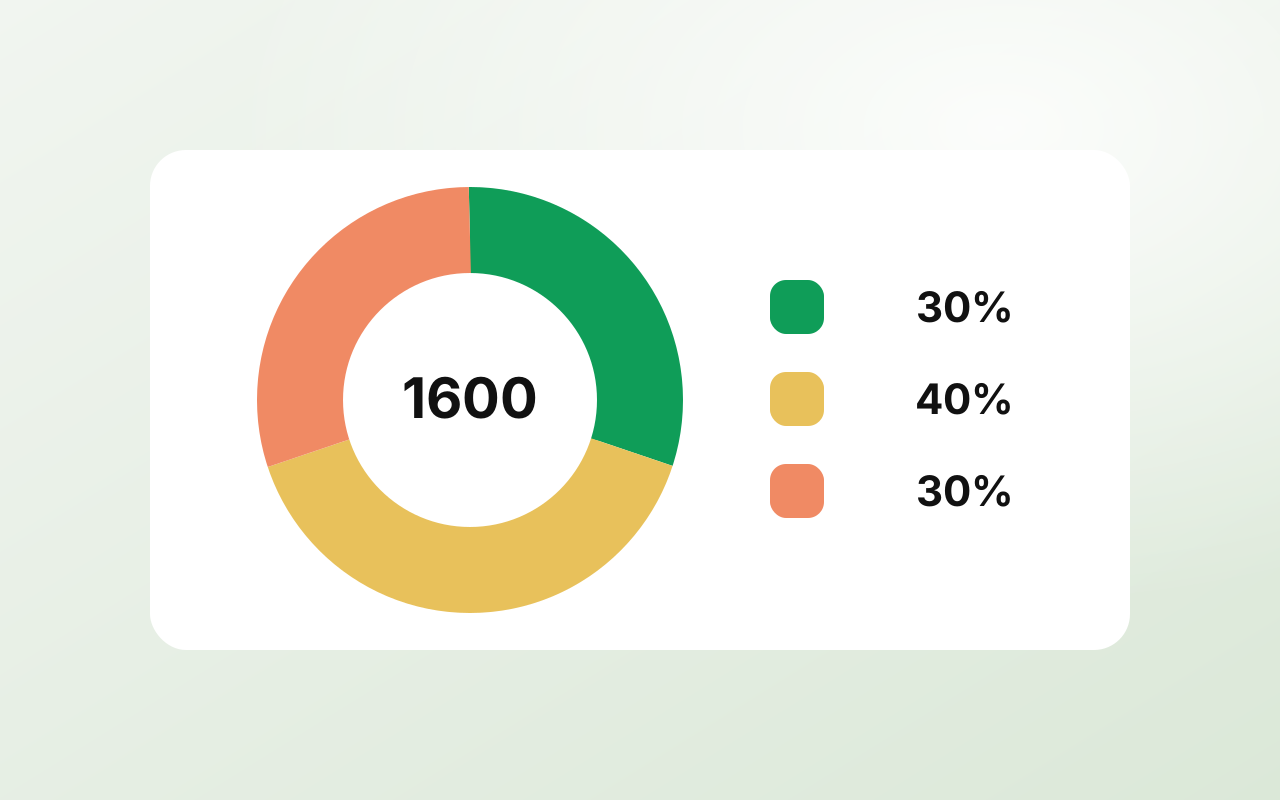
How do I convert percentages to grams? Multiply your calories by the percentage, then divide by 4 for protein and carbs or by 9 for fat. For example, 30% × 1,600 kcal = 480 kcal ÷ 4 = 120 g of protein.
Data: Mifflin MD et al., A new predictive equation for resting energy expenditure in healthy individuals, Am J Clin Nutr 1990;51:241–247; Institute of Medicine (National Academies), Dietary Reference Intakes for Energy, Carbohydrate, Fiber, Fat, Fatty Acids, Cholesterol, Protein, and Amino Acids, 2005 (acceptable macronutrient ranges, carbohydrate RDA 130 g); Gardner CD et al., Effect of low-fat vs low-carbohydrate diet on 12-month weight loss in overweight adults, JAMA 2018;319:667–679; Sacks FM et al., Comparison of weight-loss diets with different compositions of fat, protein, and carbohydrates, N Engl J Med 2009;360:859–873; Dietary Guidelines for Americans (fiber 14 g per 1,000 kcal). Food values: USDA FoodData Central, SR Legacy, by NDB number. Values checked October 2026.
Related: How to calculate your calorie deficit · How much protein per day · High-protein foods · Weight loss plateau
CalMePlease counts calories, protein, carbs and fat for every meal you add by photo, voice, barcode or text, and you can correct the grams in one tap. Free on the App Store.